
The 2026 US midterm elections have delivered a major political shift, and financial markets are already responding.
Democrats secured majorities in both the House of Representatives and Senate, changing the balance of power in Washington for the remainder of President Donald Trump’s term.
For cryptocurrency investors, however, the most interesting development may be Bitcoin’s response.
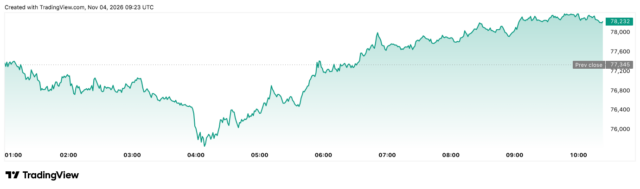
After briefly reaching a six-week low, Bitcoin recovered toward $78,000, suggesting that the initial wave of election-related selling did not continue unchecked.
We believe the bigger question now is whether this recovery can develop into sustained momentum.
What Changed After the US Midterm Elections?
The November 3 elections determined all 435 House seats and 35 Senate contests, alongside numerous state races.
Democrats emerged with control of both congressional chambers, creating a divided federal government.
For markets, this introduces uncertainty around future legislation, government spending, taxation, and regulatory policy.
However, political gridlock does not automatically translate into falling asset prices.
A divided Congress can make major legislative changes harder to pass, potentially reducing the likelihood of sudden shifts in some areas of federal policy.
We believe investors should distinguish between the immediate market reaction and the longer-term economic consequences.
The two are not always the same.
Bitcoin Rebounds After Election-Related Volatility
Bitcoin initially came under pressure as election results emerged.
According to Reuters, the cryptocurrency briefly touched a six-week low before recovering to approximately $78,070 early Wednesday.
That recovery deserves attention.
It suggests buyers were willing to re-enter the market despite uncertainty surrounding the incoming Congress.
However, we should not interpret one rebound as confirmation of a lasting rally.
We would look for Bitcoin to reclaim $80,000, maintain stronger trading volumes, and attract renewed institutional demand.
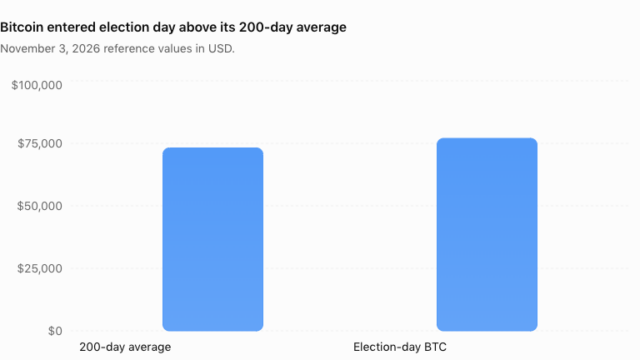
As we previously explored in our Bitcoin midterm election analysis, BTC entered election day above its 200-day moving average, unlike during the previous three midterm cycles.
That longer-term trend offers useful context for evaluating short-term volatility.
What Does the Election Mean for Crypto Regulation?
One of the biggest questions concerns cryptocurrency legislation.
During the previous Congress, lawmakers debated the CLARITY Act, which aims to establish clearer regulatory responsibilities for digital assets.
Democratic lawmakers have emphasized consumer protections, financial oversight, and safeguards against potential conflicts of interest.
Republican lawmakers have generally emphasized regulatory certainty and reducing obstacles to cryptocurrency innovation.
Both parties include legislators who support digital-asset development, although they disagree over important details.
With congressional leadership changing, negotiations may take a different direction.
We previously covered the debate surrounding Trump’s crypto market structure legislation, including unresolved questions about regulatory authority.
We believe clear and workable rules could benefit long-term cryptocurrency adoption, regardless of which party controls Congress.
Why Stocks, Bonds, and the Dollar Also Matter
The election’s impact extends beyond cryptocurrencies.
US stock futures initially declined before recovering some losses, while Treasury yields and the dollar also weakened.
Technology and artificial intelligence companies faced particular scrutiny as investors considered possible changes to regulatory oversight and infrastructure development.
This matters for Bitcoin because its short-term trading behavior can be influenced by broader investor appetite for risk.
When investors reduce exposure to technology stocks and other volatile assets, cryptocurrencies can experience similar pressure.
Conversely, improving liquidity conditions and lower borrowing costs may support demand for risk assets.
We believe Bitcoin investors should therefore monitor several indicators together: Nasdaq performance, Treasury yields, the US dollar, and cryptocurrency ETF flows.
These signals can help explain whether Bitcoin’s next move is primarily driven by political developments or broader financial conditions.
Could Bitcoin Reach $80,000 Again?
The $80,000 level remains an important near-term reference point.
With Bitcoin recovering toward $78,000, a return to that threshold would require an advance of approximately 2.5%.
However, reaching $80,000 is only part of the story.
We would want to see sustained buying activity rather than a brief price spike.
Institutional participation, ETF inflows, and developments in Washington could all influence market confidence.
We also recently examined how Bitcoin faced selling pressure ahead of the midterm elections.
For us, the key takeaway is that Bitcoin’s long-term development extends beyond any single election.
Its fixed supply, expanding financial infrastructure, and growing role in global investment markets remain important parts of its investment case.
The coming days will reveal whether the election-related recovery gains strength.
And if Bitcoin reclaims $80,000 while broader markets stabilize, investors may begin looking beyond election uncertainty toward the next phase of the cryptocurrency market.

You can get bonuses upto $100 FREE BONUS when you:
💰 Install these recommended apps:
💲 SocialGood - 100% Crypto Back on Everyday Shopping
💲 xPortal - The DeFi For The Next Billion
💲 CryptoTab Browser - Lightweight, fast, and ready to mine!
💰 Register on these recommended exchanges:
🟡 Binance🟡 Bitfinex🟡 Bitmart🟡 Bittrex🟡 Bitget
🟡 CoinEx🟡 Crypto.com🟡 Gate.io🟡 Huobi🟡 Kucoin.














Comments